Quick answers
Where is my main water shut-off valve?
If a pipe is leaking or water is flooding, finding your main shut-off fast can stop the damage. Here’s where to look and what to do next—then you can get help from a licensed, insured emergency plumber if needed.
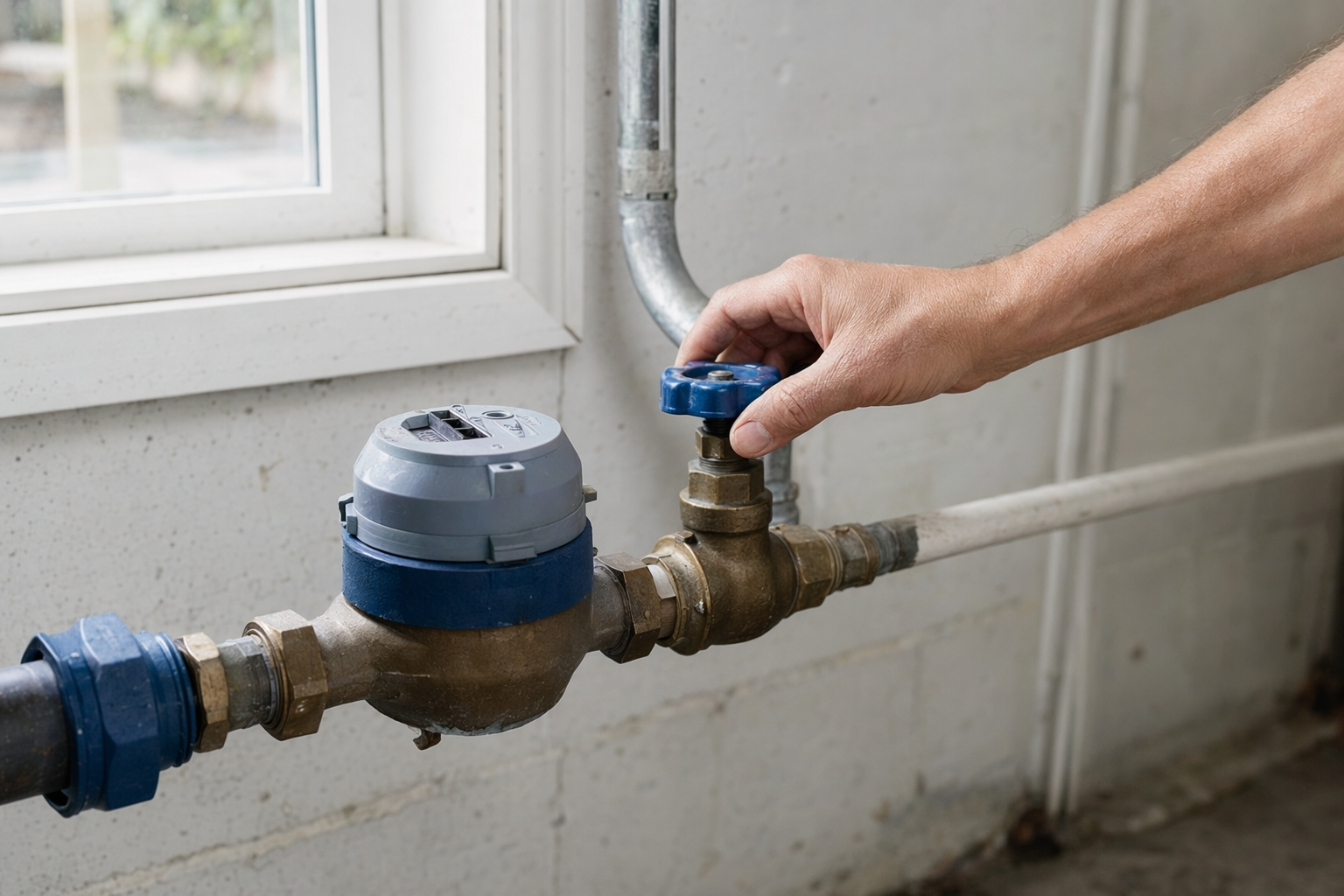
What to do right now
1. If you have an active leak or flooding, shut off your home’s main water valve if you can do so safely.
2. Open a faucet near the leak to drain a little pressure, then close it after it stops flowing (if water is still coming).
3. If water is near live electrical outlets/appliances, or you smell gas, leave the area and call your local emergency number first.
4. Take a quick photo of the leak/valve area for reference, then contact a licensed, insured 24/7 plumber if the problem isn’t clearly small and contained.
- If you can’t find the valve quickly, don’t wait—use the next shut-off option (like a nearby service shut-off) if you can.
- If the valve won’t turn, stop forcing it. A plumber can assess the safest way to shut off water.
Where the main shut-off valve usually is (most common places)
In many homes, the “main shut-off” is where all house water enters. Common locations include laundry areas, basements, garages, and the area where the water line first comes in.
Check these places first because they’re most likely:
- Near where the main water line enters your home (often by a concrete wall).
- In the basement (sometimes near a furnace/utility area) or crawlspace (if accessible).
- In a garage or utility room, especially on an interior wall.
- Next to/inside the water heater area (not always the main, but sometimes it’s close to the main).
Tip: Look for a round wheel/handle, a lever, or a valve body attached to the main pipe. The valve is often a different color than the pipes and may have a small label like “water” or “shut-off.”
- If you live in an apartment, the “main” may be in a shared utility room or not inside your unit—ask your landlord/property manager when safe.
- If you recently bought the home, the valve may have been moved from the typical spot.
Apartment vs. house: what “main shut-off” can mean
In a single-family house, the main shut-off is usually directly connected to the line that feeds the whole home.
In apartments/condos, you may not have a true building-wide main shut-off inside your unit. You may only have a local shut-off (like under a sink or behind a fixture) for that specific line. Building-wide shut-off valves are often in a hallway utility area, basement, or mechanical room.
If you’re in a rental, try to find your lease’s emergency instructions or contact your property manager. If there’s active flooding or sewage backup, you still may need an emergency plumber right away.
If you can’t find it: other shut-offs that can still reduce damage
If the main shut-off is hard to reach, frozen, or not where you expect, look for the next best option that stops water to the affected area.
Try these backup checks:
- Look for shut-off valves on the specific fixture or appliance (for example: under a sink, behind a toilet, or on the washing machine line). These may not stop water to the whole house, but they can limit the leak.
- If you have access to a garage/yard utility area, there may be a curbside or meter-area shut-off. Some systems have a main shut-off outside near the meter.
- If the water was turned off recently, check for any notes or labels on the utility panel or near the basement/utility room.
If you find a valve but it’s stuck: don’t force it during an emergency. Forcing can break parts and make the leak worse—call a licensed, insured plumber.
Red flags: when to stop and get emergency help
Some situations are not “just find the valve.” Get help quickly if you see signs that something bigger is going on.
Watch for these red flags:
- Water is spreading fast (so you can’t safely keep searching).
- The leak involves sewage, a toilet line, or a drain backing up.
- The shut-off is corroded, stuck, or you hear grinding/cracking when trying to turn it.
- You notice damp/wet ceilings, walls, or floors that are growing.
- Water is near electrical wiring, outlets, or an appliance.
For anything involving gas smell, live electricity risk, or you’re not sure it’s safe: leave the area and call local emergency services first. Then contact a plumber or the responsible utility/landlord based on your situation.
- A valve that looks “closed” may not actually stop water—if water keeps running, stop searching and get help.
- If this is a recurring issue, a plumber can also tell you whether the valve needs repair or replacement.
How to get a 24/7 licensed plumber (free matching through MainLine Match)
MainLine Match is a FREE matching service. We don’t do plumbing work, install parts, or replace valves—we connect you with licensed, insured emergency plumbers near you.
To get matched faster, tell us:
- The problem type (example: “burst pipe/flooding,” “no hot water,” “no water,” “sewage backup,” “major leak,” or “bad clog”).
- Your ZIP code.
- Your preferred language.
Then, once you connect with a plumber, confirm details before any work begins: the estimated cost range, what’s included, and the plan to address the shut-off and the leak.
Cost note: emergency plumbing costs vary a lot by area, time of day (after-hours is usually higher), and the type of repair (simple shut-off vs. pipe replacement, parts, and access). For rough budgeting, many emergency calls fall into a wide range, but the real price depends on your exact situation. Ask for a clear explanation of costs before work starts—ranges are not quotes.
- You stay in control: you choose who to hire and you confirm the price before paying the final amount.
- Avoid scams: be cautious with vague pricing, cash-only pressure, no license/insurance, or requests to authorize a huge repair on the spot.
Most main shut-offs are near where the water line enters your home (basement, laundry/utility room, garage, or utility wall), and if there’s active flooding, shut off water immediately if safe—then call a licensed, insured 24/7 plumber via MainLine Match.
Common questions
I think there’s a main shut-off valve, but I can’t find it—what should I do?
Look where the water line enters your home (basement, laundry/utility room, garage, or near the water heater) and check for any nearby shut-off valves on the affected fixtures. If you can’t stop the leak quickly, contact a licensed, insured 24/7 plumber—tell them you’re trying to locate the main shut-off and what’s flooding.
Where is the main water shut-off valve in an apartment?
Often it’s not inside your unit. Building-wide shut-offs are commonly in shared utility areas like a basement, hallway mechanical room, or near the building’s meter. If your unit has only fixture shut-offs, you may need the landlord/property manager for the building main.
The valve handle won’t turn—should I force it?
During an emergency, avoid forcing a stuck valve. Forcing can break parts and make the leak worse. Stop if it resists and call a licensed, insured plumber to shut off water safely.
How much does it cost if I need an emergency plumber to shut off water?
Costs vary by location, after-hours timing, the difficulty of accessing the valve/pipe, and what repair is needed. MainLine Match can connect you to emergency plumbers, but prices are not guaranteed—ask for a clear, itemized explanation or cost range before work starts.
If water is near outlets, is it safe to keep looking for the valve?
No—prioritize safety. If water is near electrical equipment, do not touch switches or electrical items. Leave the area and call your local emergency number first, then get plumbing help once it’s safe.