Services
Toilet, faucet and fixture repair
Start with the water. If a toilet, faucet, or other fixture is overflowing or leaking fast, shut off the nearby valve if you can. This page explains what may be a simple repair, what may need a plumber, and typical cost ranges.
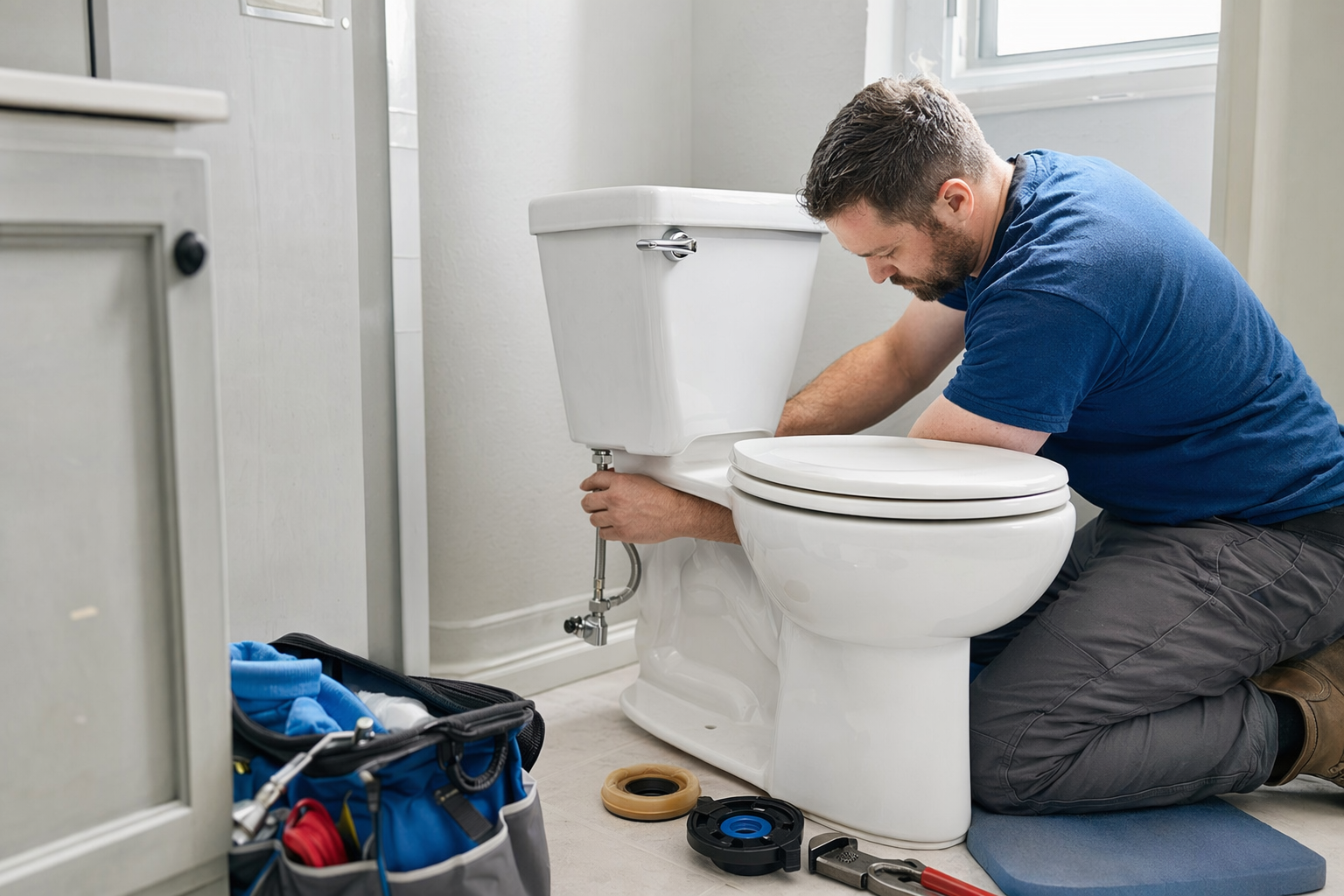
What to do right now
- If water is actively overflowing or spraying, turn off the fixture shutoff valve if you can reach it safely. For a toilet, this is often a small valve on the wall or floor behind it. If that does not stop the water, shut off the home's main water.
- Move towels, buckets, and anything that can be damaged by water. Take photos if helpful for the plumber or landlord.
- Do not keep flushing an overflowing toilet. Do not force a stuck handle or turn a broken faucet harder.
- If water is near outlets, cords, or live electrical equipment, leave the area and call your local emergency number first.
- If you need help finding a licensed, insured plumber, you can use MainLine Match. We are a free matching service, not a plumbing company, and we do not perform plumbing work.

What fixture repair usually includes
Toilet, faucet, and fixture repair covers common problems with the plumbing parts you use every day: toilets that keep running, will not flush, leak at the base, or overflow; faucets that drip, squeal, or will not shut off; shower valves that are hard to turn; broken handles; leaking supply lines; and shutoff valves that do not fully stop the water.
Sometimes the fix is small, like replacing a flapper, fill valve, cartridge, supply line, wax ring, handle, or shutoff valve. Other times the fixture problem is a sign of a bigger issue, like high water pressure, a hidden leak, a clog farther down the drain, corrosion, or old plumbing parts that no longer seal well.
A licensed plumber will usually start by finding exactly where the water is coming from and whether the problem is in the fixture itself, the water supply connection, the shutoff valve, or the drain. That matters because a toilet that overflows from a clog is different from a toilet leaking clean water from the tank or supply line.
How a plumber diagnoses and fixes it
For a toilet, the plumber may check the tank parts, the flapper seal, the fill valve, the flush valve, the handle and chain, the water level, the supply line, the shutoff valve, and the base seal. If the toilet rocks, leaks at the floor, or smells bad, they may look at the wax ring or mounting bolts. If it backs up when flushed, they may clear the clog first and then see whether the toilet itself is the issue.
For a faucet or shower fixture, the plumber may check cartridges, stems, seats, washers, aerators, handles, escutcheons, supply hoses, and the shutoff valves under the sink or behind an access panel. A drip can come from worn internal parts. Low pressure at one fixture can come from a blocked aerator, a faulty cartridge, or debris in the line. A faucet that leaks under the sink may have a loose connection, cracked line, or failing valve.
If a fixture is very old, heavily corroded, or missing replacement parts, repair may not make sense. In that case, the plumber may suggest replacing the fixture or valve. Ask what failed, what part is being replaced, and whether repair is expected to solve the problem fully or only temporarily.
What it may cost
Small fixture repairs are often less expensive than major pipe work, but prices vary a lot by area, time of day, and the parts needed. For a simple toilet repair such as replacing common tank parts, many homeowners may see a rough range around $125-$350. A clog that is straightforward to clear may be in a similar range, while a toilet reset with a new wax ring or flange-related work may run higher.
For faucet and shutoff valve repairs, a minor repair might fall around $125-$300, while replacing a cartridge, supply line, or shutoff valve may be more depending on access and corrosion. Installing a new standard faucet or toilet often costs more than a small repair because of labor time, removal of the old unit, and new parts. After-hours, weekend, or holiday service usually costs more.
If the problem turns out to involve hidden damage, water pressure issues, drain problems, or failed parts behind the wall, the real cost can rise quickly. These are general ranges, not quotes. The actual price depends on the problem, the time of day, the parts, and your area. You can read more on typical plumbing costs.
- Ask for the service call or diagnostic fee up front
- Ask whether parts are included in the written price
- Ask if after-hours rates apply before work starts
Quick fix or real problem?
Some fixture problems are small and localized. A toilet that runs but does not leak onto the floor may only need tank parts. A faucet that drips from the spout may only need an internal repair. A loose handle or worn supply line can also be a focused repair.
But some signs point to a larger issue. If the toilet backs up repeatedly, gurgles, or multiple drains are slow at the same time, the problem may be in the drain line, not the toilet alone. If water appears around the base of a toilet after flushing, the seal may have failed or water may be escaping from elsewhere. If shutoff valves are frozen, corroded, or do not work, the plumbing may be older and more fragile.
Watch for these signs that you should have a licensed plumber check it soon: recurring leaks, water stains below a bathroom or kitchen, soft flooring, mold smell, low water pressure at several fixtures, rust-colored water, or a fixture that was repaired before but keeps failing. If there is active flooding or no water service, see plumbing emergency help.
How to choose a plumber and avoid overpaying
When you are stressed, it is easy to agree too fast. Slow the process down enough to get the price in writing before work starts. Ask whether the plumber is licensed and insured for your area, and verify it if you can. Rules and license types vary by state and city.
Be careful with vague pricing, scare tactics, cash-only demands, or pressure to approve a very large repair immediately without a clear explanation. It is reasonable to ask what part failed, what they plan to replace, whether repair or replacement is better, and what the total price includes. The household stays in control: you confirm the price before work starts, choose who to hire, and confirm the work is done before paying the final amount.
MainLine Match is free for households. We are not a plumbing company and do not send our own technicians. We simply help connect you with licensed, insured plumbers near you based on your contact and problem details, such as your name, phone, optional email, ZIP code, problem type, and preferred language. You can start at our services hub or get matched here.
If a toilet or faucet is leaking or overflowing, stop the water first, then get a written price from a licensed, insured plumber before any work starts.
Common questions
My toilet is overflowing. Should I keep flushing to clear it?
No. Stop flushing and shut off the toilet's valve if you can reach it safely. If that does not stop the water, shut off the home's main water and get help.
Why does my toilet keep running even when nobody uses it?
Often the problem is inside the tank, such as a flapper or fill valve that is not sealing or shutting off correctly. A plumber can confirm the cause and replace the failed part if needed.
Is a dripping faucet an emergency?
Usually not, but it can waste water and may get worse. If the drip becomes a steady leak, the handle will not shut off, or water is leaking under the sink, it is worth having a plumber check it soon.
Can a plumber repair just the shutoff valve under my sink or toilet?
Yes, that is a common repair. Cost depends on the valve type, corrosion, access, and whether the water can be isolated safely.
How much does toilet or faucet repair cost?
Many smaller fixture repairs may fall roughly around $125-$350, but some cost less and some cost more. The real price depends on the exact problem, parts, area, and whether it is after hours; ranges are not quotes.
Do I need a plumber or can I just replace the fixture?
If the fixture is old, cracked, badly corroded, or has repeated problems, replacement may make more sense than another repair. A licensed plumber can tell you whether the issue is the fixture itself or something deeper in the plumbing.